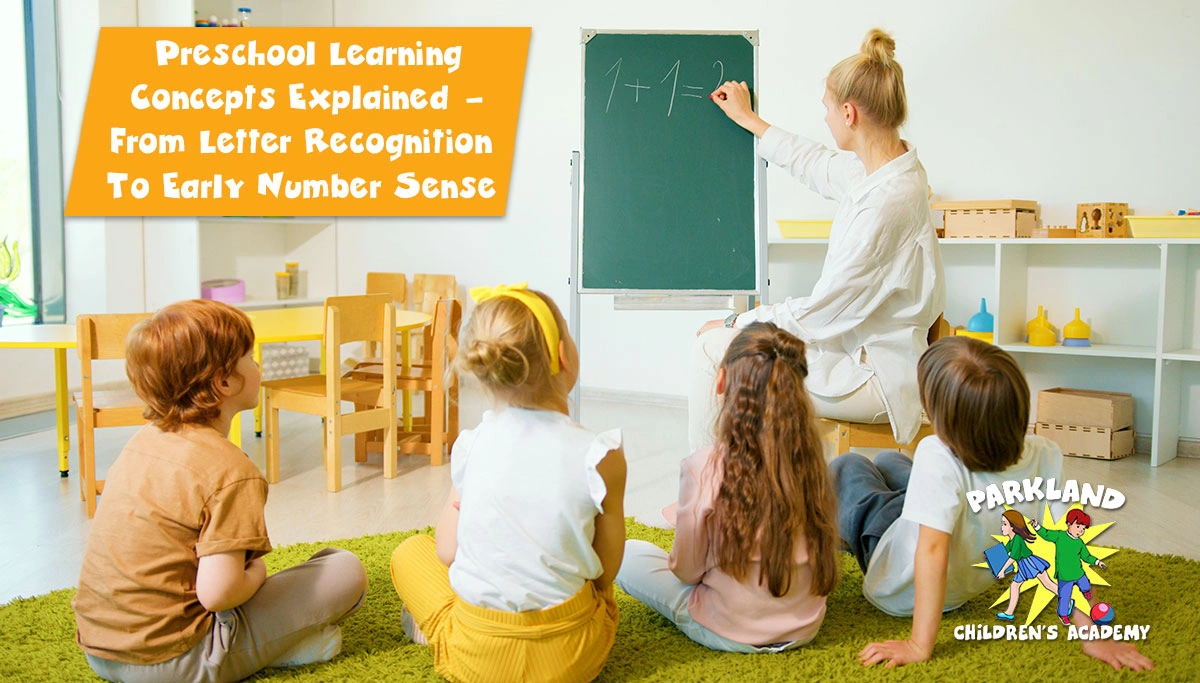
Every day in preschool is filled with opportunities to learn, explore, and grow. From recognizing letters and numbers to building vocabulary and solving simple problems, both inside the classroom setting and out on the playground.
Although these activities may seem like simple games, children are really developing foundational skills that will support their learning for years to come through hands-on activities, imaginative play, and meaningful interactions with their preschool teachers as well as friends.
Through these different preschool learning experiences, your little one is able to gain confidence in learning to communicate for themselves and others, think critically, and explore the world around them. Understanding these key literacy and numeracy concepts can help parents support their children as they take their first steps towards a lifetime of learning.
Literacy Development

Developing language and literary skills from an early age is so important to a child’s overall development. It is what they use to express themselves to friends and family, and how they engage in play. The literacy skills that they develop at a young age become the building blocks for their future academic success.
Having a strong foundation of language and literary skills will help them to be more confident when communicating with others, enhance their comprehension skills, and may foster a love for reading and learning which will help them throughout their academic and professional careers.
Letter recognition

Before children begin reading independently, they must first be able to recognize letters. This means knowing the alphabet and the sounds associated with each letter.
Why It Is Important
Letter recognition is the base of all reading and writing. Building up this preschool skill is essential for a child to continue on into kindergarten.
Activities That Build Letter Recognition:
Tracing letters
- Learning the difference between upper- and lower-case
Letter scavenger hunt
- Hide different upper- and lower-case letters around the room; as your child finds them, have them name the letter and the sound associated with it.
Sidewalk Letters
- Have your little one draw out different letters on the sidewalk spaced out. Once done, call out different letters and have them jump to the right one.
Phonics
Phonics teaches children the relationship between letters and the sounds that they represent. By learning the different phonics of each letter, children are able to sound out unfamiliar words while reading story books, and apply those same sound patterns when learning to spell.
Why It Is Important
- Allows children to decode words on their own
- Important for learning how to spell
- Builds up their confidence when reading and spelling
Vocabulary Development
Vocabulary development focuses on helping children learn new words and understand their meanings. The more words they are exposed to, the easier it becomes for them to communicate, read, and express themselves.
Why Is It Important
By actively working on improving a child’s vocabulary, especially in the early years such as preschool, you allow them to express their thoughts and feelings clearly, ask more meaningful questions, and better understand the stories they read.
Activities To Build Vocabulary
- Having story time in the preschool as well as sending books home
- Guided conversations between teachers and children
- Introducing new words naturally within everyday conversations
- Reading new stories
Numeracy Development
Early numeracy skills, such as exploring numbers, patterns, shapes, and measurement, build mathematical confidence and strengthen logical problem-solving skills.
When children explore these different areas of numeracy development, they do more than just learn math. They build the confidence and logical thinking skills needed to solve everyday problems as they move from preschool and onwards.
Number Recognition
Number recognition is the ability to visually identify, name, and understand written numerals.
Why Is It Important
- Prepares children for basic arithmetic equations involving adding and subtracting
- Can count accurately
- Follows patterns and number sequences
- Builds confidence early on with math concepts
Activities To Learn Numbers
- Count how many people are in their preschool class
- Number matching cards
- Roll a die and say what number you rolled between the two
- Colour by number
Problem Solving
Problem solving encourages children to think critically and explore different solutions.
Activities Could Include:
- Completing a puzzle
- Cooperative games that encourage children to work together
- Pattern blocks
One-To-One Correspondence
One-to-one correspondence is a skill adults perform automatically, but one that children must learn through practice. It involves assigning exactly one number to each object while counting, ensuring that every item in a set is counted only once.
Activities To Practice One-To-One Correspondence:
- Create a bead necklace with a specific number of beads
- Build LEGO towers as high as specified
- Count the number of snacks they have of a certain item, such as crackers or grapes
Patterns And Shapes
Shapes and patterns are everywhere in a preschooler’s world! Through hands-on play with blocks, beads, and other games, children learn to spot repeating sequences and identify different geometric forms, which all aids in them gaining the spatial awareness to see how things fit together.
Activities Could Include:
- Completing pattern worksheets
- Finger painting different shapes
- Shape bingo
- Finding shapes in nature
Basic Arithmetic
Learning basic arithmetic in preschool helps children build the foundational blocks that they will need for more advanced mathematical concepts later in school. Basic math skills help children make sense of the world around them, such as learning how to split a snack fairly between friends.
Some Activities Include:
- Measuring ingredients while baking or cooking
- Simple dice math games
- Activity sheets
Preschool Learning In Parkland

The literacy and numeracy skills children develop during their preschool years lay the foundation for future success both inside and outside the classroom. By encouraging letter and number recognition, vocabulary growth, problem-solving, and other early learning concepts through fun, engaging activities, children build the confidence and curiosity they need to thrive.
Every child learns at their own pace, but with consistent encouragement and opportunities to explore, these early experiences can foster a lifelong love of learning and prepare them for a smooth transition into kindergarten and beyond.
A strong start starts with the right preschool learning. For more information, call Parkland Children’s Academy today at (954) 688-5877.